 MElkhateeb
➡️ Introduction
One of the most common challenges in project management is dealing with limited resources. Even the most carefully planned schedules can fail if people, equipment, or materials are overallocated.
Top 5 Project Management Software
This is where resource optimization techniques come into play. Two of the most important techniques are Resource Leveling and Resource Smoothing.
While these terms are often used interchangeably, they serve different purposes, have different impacts on the schedule, and are applied in different situations. Understanding the distinction is critical for maintaining realistic timelines and sustainable workloads.
✅ What Is Resource Leveling?
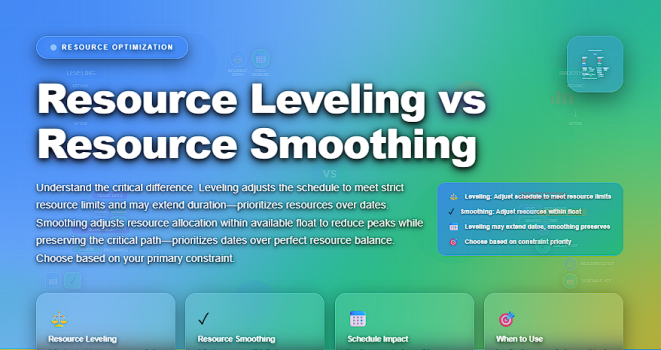
Resource leveling is a technique used to resolve resource overallocations by adjusting the project schedule, even if it means extending the project duration.
In simple terms:
Resource leveling prioritizes resource availability over deadlines.
Key Characteristics
✔️ Used when resources are limited or fixed
✔️ May delay tasks or milestones
✔️ Can change the project end date
✔️ Focuses on avoiding burnout and overload
Typical Use Cases
- Small teams with limited staff
- Projects sharing resources across departments
- Highly specialized skills that cannot be duplicated
- Situations where quality and sustainability matter more than speed
✅ What Is Resource Smoothing?
Resource smoothing adjusts activities within the existing schedule flexibility (float/slack) to reduce peaks and valleys in resource usage — without changing the project end date.
In simple terms:
Resource smoothing prioritizes meeting deadlines while improving workload balance.
Key Characteristics
✔️ Uses available float
✔️ Does NOT change the project completion date
✔️ Less disruptive than leveling
✔️ Ideal when deadlines are fixed
Typical Use Cases
- Projects with firm contractual deadlines
- When minor workload adjustments are enough
- Organizations focused on delivery speed
- Agile or hybrid environments with time-boxing
✅ Resource Leveling vs Resource Smoothing
Key differences every project manager should understand.
| Aspect | Resource Leveling | Resource Smoothing |
|---|---|---|
| Primary Goal | Resolve resource overallocations | Optimize workload within schedule |
| Impact on Schedule | May extend project duration | Does not change end date |
| Use of Float | May exceed available float | Uses only available float |
| Deadline Flexibility | Flexible deadlines | Fixed deadlines |
| Risk of Delays | Higher | Low |
| Best Used When | Resources are constrained | Time is constrained |
✅ When Should You Use Resource Leveling?
Use resource leveling when:
✔️ You have fixed or scarce resources
✔️ Overallocations are severe
✔️ Burnout risk is high
✔️ Quality and sustainability are priorities
✔️ Deadlines can be adjusted
Example:
A senior engineer is assigned to five parallel tasks. Leveling delays some tasks to match availability.
✅ When Should You Use Resource Smoothing?
Use resource smoothing when:
✔️ Project deadlines are non-negotiable
✔️ There is available float
✔️ Minor adjustments can solve overloads
✔️ You want to preserve the baseline schedule
Example:
Tasks are shifted slightly within float to balance workload without affecting milestones.
❌ Common Mistakes to Avoid
❌ Confusing leveling with smoothing
❌ Leveling critical path tasks without approval
❌ Ignoring human capacity limits
❌ Overusing overtime instead of rescheduling
❌ Failing to re-baseline after leveling
⭐ Best Practices for Resource Optimization
✔️ Analyze resource allocation early
✔️ Monitor workloads weekly
✔️ Use leveling for sustainability
✔️ Use smoothing for deadline protection
✔️ Communicate schedule impacts clearly
✔️ Update baselines when required
⭐ Final Thoughts
Resource Leveling and Resource Smoothing are not competing techniques — they are complementary tools.
Great project managers know when to protect the schedule and when to protect the team.
Deadlines matter.
But burned-out teams fail faster.