 MElkhateeb
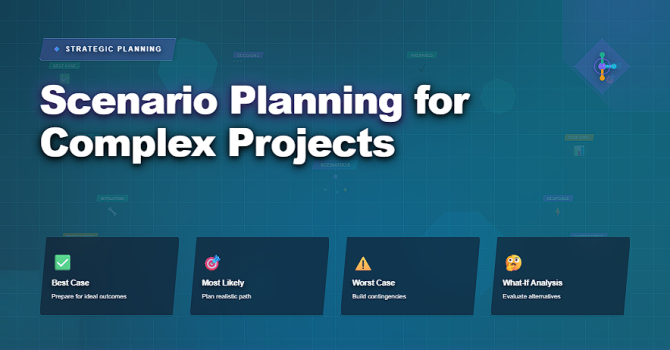
➡️ Introduction
Complex projects do not fail because teams lack plans.
They fail because teams plan for only one future.
Top 5 Project Management Software
In environments with high uncertainty, interdependencies, and external influences, a single “most likely” plan is fragile. When reality deviates — and it always does — decision-makers are forced into reactive mode.
Scenario planning addresses this weakness.
It prepares project teams for multiple plausible futures, allowing them to respond deliberately instead of improvising under pressure. For complex projects, scenario planning is not a theoretical exercise — it is a practical control discipline.
This article explains how scenario planning works, when to use it, and how project managers can apply it to manage complexity with confidence.
✅ What Scenario Planning Really Is
Scenario planning is not prediction.
It is preparedness.
In project management, scenario planning means:
✔️ identifying key uncertainties
✔️ defining multiple plausible future states
✔️ understanding how each scenario affects scope, schedule, cost, and risk
✔️ preparing response strategies in advance
Instead of asking “What will happen?”, scenario planning asks:
“What could happen — and how will we respond?”
✅ Why Complex Projects Need Scenario Planning
Complex projects typically include:
✔️ many interdependent workstreams
✔️ external stakeholders or regulators
✔️ long durations
✔️ evolving requirements
✔️ limited historical data
In such conditions, linear planning breaks down quickly. Scenario planning restores control by expanding the decision space before pressure arrives.
✅ Common Scenarios in Complex Projects
What to plan for before uncertainty materializes.
| Scenario | What Changes | Why It Matters |
|---|---|---|
| Delayed External Dependency | Approvals, vendors, or inputs arrive late | Critical path disruption |
| Resource Availability Shift | Key experts become unavailable | Capacity constraints |
| Scope Expansion | New requirements added mid-stream | Schedule and cost impact |
| Technical Risk Materializes | Unexpected complexity or defects | Rework and delay risk |
| External Environment Shift | Regulatory, market, or policy changes | Strategic realignment required |
✅ How to Build Scenarios Step by Step
Effective scenario planning follows a clear process:
✔️ identify the few uncertainties that matter most
✔️ define realistic alternative outcomes
✔️ assess impact on timeline, resources, and risk
✔️ design response strategies for each scenario
✔️ identify early warning indicators
✔️ revisit scenarios periodically
The goal is not completeness — it is usefulness.
❌ Common Mistakes in Scenario Planning
❌ creating too many scenarios
❌ focusing on extreme, unrealistic events
❌ treating scenarios as static documents
❌ failing to link scenarios to decisions
❌ not communicating scenarios to stakeholders
Scenario planning fails when it becomes theoretical.
⭐ How Scenario Planning Improves Decision-Making
When done well, scenario planning:
✔️ accelerates response time
✔️ reduces emotional decision-making
✔️ clarifies trade-offs
✔️ protects credibility
✔️ increases leadership confidence
Preparedness creates calm.
⭐ When to Use Scenario Planning
Scenario planning is most valuable when:
✔️ uncertainty is high
✔️ decisions are hard to reverse
✔️ recovery options are limited
✔️ multiple stakeholders are involved
✔️ timelines are sensitive
Not every project needs it — complex ones do.
⭐ Final Thoughts
Scenario planning does not eliminate uncertainty.
It removes surprise.
Strong project managers do not wait for complexity to overwhelm them.
They anticipate, prepare, and decide with intent.
Complex projects succeed not because the future is predictable —
but because teams are ready for more than one version of it.