 MElkhateeb
➡️ Introduction
Most project delays are not caused by effort or skill.
They are caused by unclear task dependencies.
Top 5 Project Management Software
When teams do not clearly understand which tasks must happen before others, work starts in the wrong order, handoffs fail, and waiting time increases. Even well-built schedules can collapse if dependencies are missing or misunderstood.
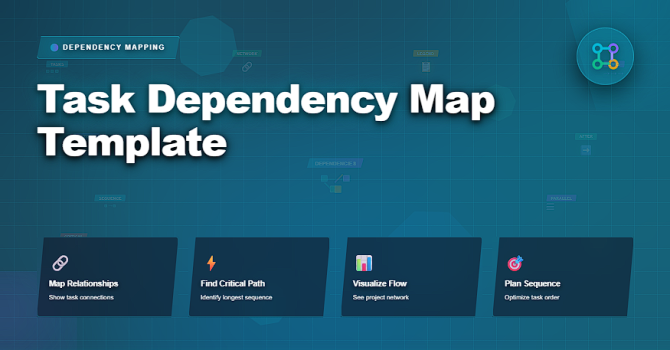
A task dependency map template brings order to this complexity.
It visually and logically shows how tasks relate to each other, making the flow of work explicit and manageable. For project managers, it becomes a powerful tool for planning, risk control, and communication.
This article explains what a task dependency map template is, what it should include, and how to use it effectively in real projects.
✅ What a Task Dependency Map Really Is
A task dependency map is a structured representation of how tasks are connected.
It shows:
✔️ which tasks must start or finish before others
✔️ where handoffs occur
✔️ which tasks are waiting on inputs
✔️ where delays can cascade
✔️ which paths are most critical
Unlike a simple task list, a dependency map explains why timing matters.
✅ Why Dependency Mapping Is Essential
Without clear dependency mapping:
✔️ teams work out of sequence
✔️ rework increases
✔️ bottlenecks stay hidden
✔️ schedule risks appear late
✔️ accountability becomes unclear
A dependency map transforms a plan from a list of tasks into a coherent execution system.
✅ Key Components of a Task Dependency Map
What to include for clarity, sequencing, and control.
| Component | Description | Why It Matters |
|---|---|---|
| Task Name | Clearly defined activity | Prevents ambiguity |
| Predecessor | Task that must occur first | Defines execution order |
| Successor | Task that follows | Shows downstream impact |
| Dependency Type | Finish-to-start, start-to-start, etc. | Improves schedule accuracy |
| Owner | Responsible role or team | Clarifies accountability |
| Notes / Constraints | Assumptions, risks, or blockers | Adds execution context |
✅ How to Use a Task Dependency Map Template
To use the template effectively:
✔️ list all key tasks first
✔️ identify logical predecessors and successors
✔️ validate dependencies with the team
✔️ highlight critical dependency chains
✔️ update the map when plans change
✔️ review dependencies in status meetings
Dependency mapping should happen before dates are finalized.
❌ Common Dependency Mapping Mistakes
❌ assuming dependencies instead of confirming them
❌ mapping only technical dependencies
❌ ignoring external or approval-based dependencies
❌ failing to update the map after changes
❌ overcomplicating the structure
Simple, accurate dependencies are better than complex guesses.
⭐ Best Practices
✔️ keep dependency maps readable
✔️ focus on true constraints, not preferences
✔️ revisit dependencies during replanning
✔️ use the map to explain delays clearly
✔️ integrate dependency thinking into scheduling
✔️ treat dependencies as living logic
⭐ Final Thoughts
A task dependency map template is not an extra planning artifact.
It is the logic backbone of your schedule.
When dependencies are clear, teams move with confidence, risks surface early, and timelines become realistic.
Projects succeed not because tasks exist —
but because the order and relationships between them are understood and managed.