
 MElkhateeb
➡️ Introduction
Accurate time estimation is one of the most important skills in project management. Whether you’re planning a large, multi-phased initiative or a short, fast-moving assignment, the schedule depends on realistic predictions of how long each task will take.
Top 5 Project Management Software
Poor time estimates can lead to:
❌ missed deadlines
❌ budget overruns
❌ unrealistic expectations
❌ stressed teams and stakeholders
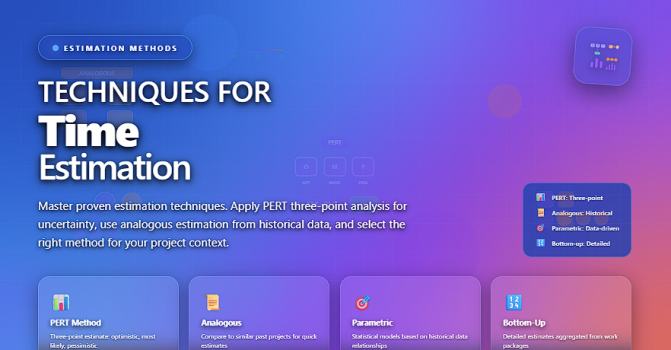
To prevent these issues, project managers rely on structured estimation methods. Two of the most widely used techniques are:
✔️ PERT (Program Evaluation and Review Technique)
✔️ Analogous Estimating
This article explains how both methods work, when to use each one, and how they strengthen your project planning.
✅ What Is PERT Estimation?
PERT (Program Evaluation and Review Technique) provides a probabilistic estimate based on three values:
- Optimistic time (O) – The best-case scenario
- Most likely time (M) – The realistic duration
- Pessimistic time (P) – The worst-case scenario
PERT helps project managers manage uncertainty by calculating a weighted average.
✔️ PERT Formula
[
\text{PERT Estimate} = \frac{O + 4M + P}{6}
]
This formula gives more weight to the “most likely” estimate, producing a balanced duration that reflects realistic expectations.
✅ What Is Analogous Estimation?
Analogous estimating uses historical data from previous projects or tasks that are similar in scope, complexity, or size.
It is:
✔️ fast
✔️ cost-effective
✔️ best for early planning
✔️ ideal when limited information is available
Example:
If building a webpage took 10 hours last quarter, a similar page today may also take about 10 hours.
Analogous estimating relies heavily on expert judgment and past performance records.
✅ PERT vs Analogous Estimation
Key differences to help project managers choose the right technique.
| Aspect | PERT Estimation | Analogous Estimation |
|---|---|---|
| Approach | Probabilistic and calculation-based. | Experience-based and historical. |
| Inputs Required | Optimistic, Most Likely, Pessimistic time. | Previous project durations. |
| Accuracy Level | High accuracy for uncertain tasks. | Medium accuracy; good for early phases. |
| Use Cases | Complex or unfamiliar tasks. | Quick high-level estimates. |
| Time Required | Slower, requires deeper analysis. | Very fast; minimal effort. |
✅ When to Use PERT
Use PERT when:
✔ tasks are new or highly uncertain
✔ assumptions may vary
✔ precision matters
✔ you want to estimate best-case vs worst-case scenarios
PERT is ideal for R&D, engineering, complex IT work, and innovation projects.
✅ When to Use Analogous Estimating
Use Analogous estimation when:
✔ the project is similar to previous work
✔ there is limited information early in planning
✔ estimates need to be fast
✔ expert judgment is available
This technique is commonly used during feasibility studies or early planning phases.
✅ Best Practices for Accurate Time Estimation
✔️ Break work down using a WBS before estimating
✔️ Involve the people who will actually perform the work
✔️ Compare estimates with historical performance data
✔️ Avoid being overly optimistic — add contingency
✔️ Use both PERT and Analogous where possible for cross-checking
✔️ Document assumptions behind every estimate
⭐ Final Thoughts
Effective time estimation is essential for building a realistic project schedule.
PERT helps you manage uncertainty with structured analysis, while Analogous estimating gives you a fast and practical starting point.
Together, these techniques improve planning accuracy, stakeholder trust, and overall project predictability.
The best project managers don’t guess time — they estimate intelligently.