 MElkhateeb
Introduction
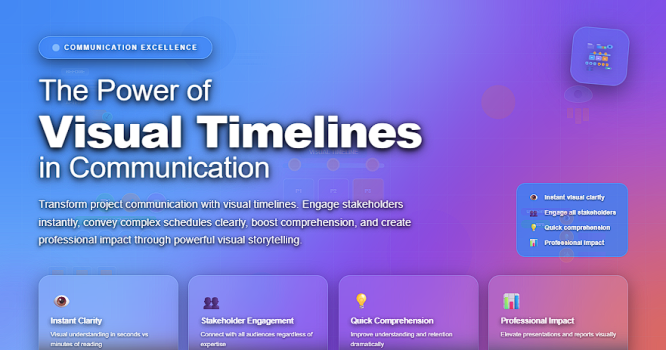
Communication is one of the most frequent causes of project success—or failure. Many project challenges do not stem from poor planning, but from poor understanding. Visual timelines address this problem by turning complex schedules into clear, shared narratives.
Top 5 Project Management Software
✅ Visual timelines simplify complex information
✅ They align stakeholders with different perspectives
✅ They reduce misunderstandings and misinterpretations
When used correctly, visual timelines become one of the most powerful communication tools available to project managers.
What Is a Visual Timeline?
A visual timeline is a graphical representation of time-based activities. Instead of relying solely on text or tables, it shows tasks, milestones, and phases along a horizontal time scale.
A visual timeline helps answer:
✅ What happens first, next, and last?
✅ How long does each phase take?
✅ Where do tasks overlap or depend on one another?
By making time visible, timelines make plans easier to understand and discuss.
Why Visual Timelines Improve Communication
Different stakeholders process information in different ways. Visual timelines bridge these differences.
They improve communication by:
✅ Reducing the need for lengthy explanations
✅ Making relationships between tasks immediately clear
✅ Highlighting priorities and constraints visually
✅ Supporting faster decision-making
A timeline can communicate in seconds what might take several paragraphs to explain.
Visual Timelines and Stakeholder Alignment
Stakeholders often care more about when outcomes occur than how individual tasks are performed.
Visual timelines:
✅ Focus attention on milestones and key dates
✅ Help executives see progress at a glance
✅ Create a shared reference point for discussions
This alignment reduces conflicting expectations and increases confidence in the plan.
Supporting Clarity in Complex Projects
As projects grow in size and complexity, communication becomes harder.
Visual timelines help by:
✅ Breaking complexity into understandable segments
✅ Showing dependencies without technical language
✅ Making risks and bottlenecks easier to spot
Instead of overwhelming audiences with details, timelines present the big picture clearly.
Visual Timelines as a Decision-Making Tool
Timelines are not just for reporting—they actively support decisions.
They help teams:
✅ Evaluate the impact of changes
✅ Compare alternative scenarios
✅ Understand trade-offs between time, scope, and resources
When stakeholders can see the consequences of a decision, discussions become more productive.
Improving Engagement and Buy-In
People are more likely to support plans they understand.
Visual timelines:
✅ Increase engagement during meetings
✅ Encourage constructive feedback
✅ Reduce resistance caused by confusion
A timeline turns planning into a collaborative conversation rather than a one-way explanation.
Common Forms of Visual Timelines
Different projects require different timeline styles.
Common examples include:
✅ Gantt charts for detailed planning
✅ Milestone timelines for executive updates
✅ Phase-based timelines for high-level communication
The key is choosing a format that matches the audience’s needs.
Common Mistakes When Using Visual Timelines
Despite their benefits, visual timelines can lose effectiveness if misused.
Common mistakes include:
✅ Overloading timelines with too much detail
✅ Using visuals without explaining assumptions
✅ Failing to keep timelines updated
✅ Treating visuals as decoration instead of communication tools
Clarity should always take priority over aesthetics.
Best Practices for Effective Visual Timelines
Experienced project managers follow these principles:
✅ Keep visuals simple and focused
✅ Highlight milestones and critical paths
✅ Use consistent time scales and labels
✅ Update timelines regularly
✅ Adapt the level of detail to the audience
A good visual timeline communicates clearly without needing constant explanation.
Visual Timelines in the Digital Age
Modern tools have expanded the power of visual timelines.
Today’s timelines can:
✅ Update dynamically as data changes
✅ Support collaboration across teams
✅ Be shared instantly with stakeholders
Despite the tools, the core principle remains the same: make time visible and understandable.
Final Thoughts
Visual timelines are more than charts—they are communication bridges. They connect planners with decision-makers, teams with stakeholders, and strategy with execution.
✅ Strong timelines create shared understanding
✅ Weak timelines create confusion
Project managers who master visual timelines do more than manage schedules—they lead conversations, align expectations, and guide projects toward successful outcomes.