 MElkhateeb
➡️ Introduction
Constraints do not fail suddenly.
They are violated gradually.
Top 5 Project Management Software
Most projects exceed deadlines, budgets, or capacity not because constraints were unknown — but because early violations were invisible, tolerated, or rationalized. By the time the problem is undeniable, recovery options are limited and expensive.
Tracking constraint violations is not about blame or control.
It is about early detection and informed decision-making.
This article explains what constraint violations really are, why they go unnoticed, and how project managers can systematically track them before they escalate into major delivery failures.
✅ What a Constraint Violation Really Is
A constraint violation occurs when actual project behavior exceeds agreed limits.
Common examples include:
✔️ work exceeding planned capacity
✔️ tasks slipping beyond approved deadlines
✔️ scope growing without time or resource adjustment
✔️ budget consumption outpacing progress
✔️ quality thresholds being compromised
Violations often start small — and become normalized.
✅ Why Constraint Violations Are Hard to See
Constraint violations are rarely announced.
They hide behind:
✔️ optimistic status reporting
✔️ partial progress masking delays
✔️ overtime compensating for overload
✔️ informal scope additions
✔️ delayed decision-making
✔️ “temporary” exceptions that never end
The project appears active — but control is already slipping.
✅ Common Constraint Violations
Early indicators that project limits are being exceeded.
| Constraint Area | Violation Signal | Why It Matters |
|---|---|---|
| Time | Tasks consistently start or finish late | Indicates unrealistic sequencing or capacity |
| Resources | Persistent overtime or multitasking | Masks overload and accelerates burnout |
| Scope | New work added without trade-offs | Erodes schedule and cost control |
| Cost | Spend increases faster than progress | Signals efficiency or estimation issues |
| Quality | Rising defects or rework | Indicates unsustainable compression |
| Capacity | More work assigned than available time | Creates invisible schedule risk |
✅ How to Track Constraint Violations Effectively
Tracking requires intentional indicators, not just status updates.
Effective techniques include:
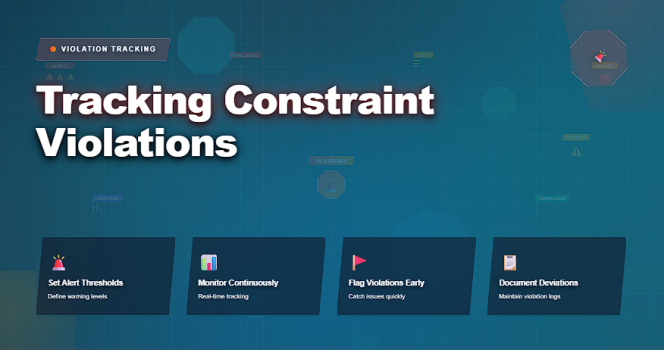
✔️ comparing planned vs actual workload weekly
✔️ monitoring trend lines, not single data points
✔️ tracking work-in-progress limits
✔️ reviewing resource utilization realistically
✔️ validating schedule float erosion
✔️ correlating progress with cost consumption
Violations are patterns — not one-off events.
✅ Making Violations Visible Without Creating Fear
Tracking fails when people hide problems.
Project managers should:
✔️ frame violations as system signals, not personal failures
✔️ encourage early reporting
✔️ reward transparency
✔️ separate problem detection from problem ownership
✔️ focus discussions on options, not blame
Visibility enables correction.
❌ Common Mistakes in Tracking Violations
❌ tracking too many indicators
❌ relying on self-reported “green” status
❌ ignoring overtime as a warning sign
❌ treating violations as exceptions
❌ waiting for formal thresholds to be crossed
❌ failing to act on early signals
Tracking without response is meaningless.
⭐ Best Practices
✔️ define constraint limits explicitly
✔️ track violations continuously, not monthly
✔️ review violations in planning meetings
✔️ connect violations to trade-off decisions
✔️ adjust plans when violations persist
✔️ document decisions and rationale
⭐ Final Thoughts
Constraints do not break projects.
Ignoring their violation does.
Strong project managers track constraint behavior as carefully as task completion. They detect imbalance early, adjust deliberately, and preserve credibility through transparency.
Projects succeed not because constraints are rigid —
but because violations are managed before they escalate.