 MElkhateeb
➡️ Introduction
Milestones are the backbone of project visibility. They show where the project is, what has been achieved, and what remains at risk.
But in today’s fast-moving environments, checking milestones only during weekly or monthly reviews is no longer enough.
Top 5 Project Management Software
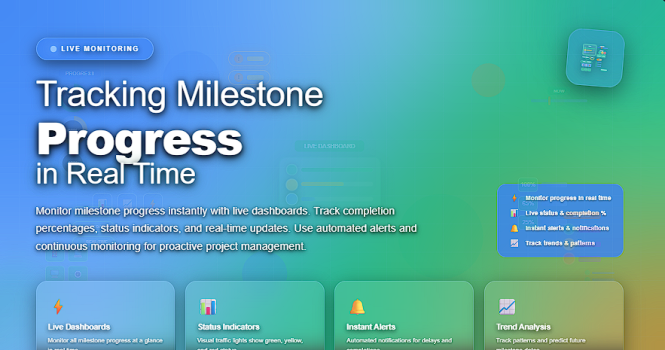
Project managers must be able to see progress in real time — identifying delays the moment they happen, adjusting resources early, and communicating updates with confidence.
Real-time milestone tracking transforms project control from reactive to proactive, enabling better decisions, faster responses, and stronger alignment across stakeholders.
✅ What Does Real-Time Milestone Tracking Mean?
Real-time tracking means the project manager has up-to-date visibility into the status of critical checkpoints, without waiting for manual updates or periodic reporting.
It provides answers instantly:
✔️ Is the milestone on track?
✔️ Is there a delay developing?
✔️ Who is responsible for the next action?
✔️ What risks could impact upcoming milestones?
Real-time tracking is essential for Agile teams, distributed teams, and high-risk or time-sensitive projects.
✅ Why Real-Time Tracking Matters
Here’s why modern PMs rely heavily on it:
✔️ 1. Early Detection of Variances
Instead of discovering issues weeks later, teams spot slippage immediately — when it’s still fixable.
✔️ 2. Faster Decision-Making
Real-time data empowers PMs to reallocate resources or escalate blockers without delay.
✔️ 3. Improved Stakeholder Confidence
Executives and clients appreciate transparency. Real-time milestone data builds trust.
✔️ 4. Better Risk Prevention
If a milestone is drifting, PMs can activate contingency plans before deadlines collapse.
✔️ 5. Stronger Accountability
Each team member knows their contribution is visible and time-sensitive.
✅ Tools That Enable Real-Time Milestone Tracking
✔️ Cloud-Based PM Software
Tools like Monday.com, Smartsheet, Asana, Jira, ClickUp, MS Project Online automatically update milestone status the moment tasks are completed.
✔️ Integrated Dashboards
Dashboards provide visual indicators:
- green → on track
- yellow → at risk
- red → delayed
These dashboards refresh automatically without manual input.
✔️ Automation and Triggers
System triggers notify PMs when:
- tasks are overdue
- dependencies are blocked
- unexpected changes occur
✔️ Time-Tracking Systems
Integrating timesheets or effort logs gives PMs real insight into whether upcoming milestones are realistic.
✔️ AI-Powered Forecasting
Modern systems predict milestone delays based on patterns in team performance, past data, or current workload.
✅ Best Practices for Monitoring Milestones in Real Time
✔️ 1. Break Milestones Into Measurable Components
A milestone that lacks measurable deliverables cannot be tracked accurately.
Example:
❌ “Design phase complete”
✔️ “UI wireframes approved by client”
✔️ “Technical architecture reviewed by engineering lead”
✔️ 2. Use Dependency Mapping
Milestones often fail because a dependent task is late.
Real-time mapping shows how one delay affects the entire timeline.
✔️ 3. Implement Automated Alerts
Set notifications for:
✔️ overdue tasks
✔️ stalled assignments
✔️ risks impacting milestones
✔️ new blockers raised by the team
Automations reduce manual follow-up.
✔️ 4. Hold Short Daily or Weekly Syncs
Real-time tools work best when combined with brief and focused discussions.
Ask:
➡️ What was completed?
➡️ What’s blocking progress?
➡️ Are milestone dates still realistic?
✔️ 5. Keep Stakeholders Informed
Use dashboards or auto-generated reports to give clients or sponsors instant visibility — without increasing your manual work.
✔️ 6. Pair Milestones With Risks
Each milestone should have a mini risk assessment:
✔️ possible delays
✔️ resource constraints
✔️ technical uncertainties
This improves forecasting accuracy.
✔️ 7. Maintain a Single Source of Truth
All milestone updates must be captured in one system — not scattered across emails, sheets, and chat tools.
⭐ Final Thoughts
Real-time milestone tracking is a key differentiator between traditional project control and modern project leadership.
It gives PMs the clarity needed to anticipate challenges, manage expectations, and guide teams toward timely delivery.
The earlier you see problems, the faster you can solve them —
and the stronger your project outcomes become.