 MElkhateeb
➡️ Introduction
Busy environments do not fail because people are idle.
They fail because priorities become invisible.
Top 5 Project Management Software
When requests arrive constantly, deadlines overlap, and stakeholders push in different directions, teams often respond by working harder instead of working clearer. The result is confusion, context switching, missed commitments, and decision fatigue — even among experienced professionals.
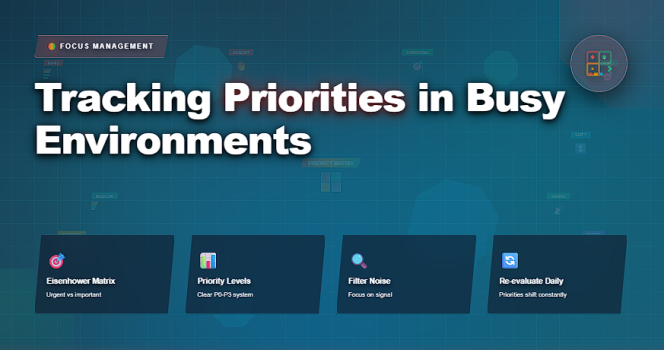
Tracking priorities is not about adding another tool or list.
It is about creating a shared, reliable signal for what matters most — right now.
This article explains why priorities are hard to track in busy environments, what effective priority tracking looks like, and how managers and project leaders can maintain focus without slowing execution.
✅ Why Priorities Get Lost Under Pressure
In busy environments, priority confusion usually comes from:
✔️ too many concurrent initiatives
✔️ constant “urgent” requests
✔️ unclear decision ownership
✔️ shifting stakeholder expectations
✔️ lack of visible trade-offs
✔️ outdated plans still being followed
When everything feels important, nothing truly is.
✅ What Effective Priority Tracking Really Means
Effective priority tracking does not mean tracking every task.
It means:
✔️ clearly defining the top outcomes
✔️ limiting what is considered “active”
✔️ making priorities visible and shared
✔️ revisiting priorities as conditions change
✔️ removing or deferring lower-value work
Priority tracking is a decision system, not a reporting system.
✅ Priority Tracking Practices That Work Under Pressure
How leaders maintain focus in fast-moving environments.
| Practice | How It’s Applied | Why It Works |
|---|---|---|
| Top-Outcome Definition | Limit focus to 3 critical outcomes | Prevents overload and confusion |
| Active Work Limits | Restrict how many priorities are active | Improves focus and flow |
| Visible Priority Board | Make priorities visible to all stakeholders | Creates shared understanding |
| Regular Re-Prioritization | Review priorities weekly or during change | Keeps focus aligned with reality |
| Explicit Trade-Offs | Remove or defer work when adding new priorities | Protects capacity and credibility |
✅ How Leaders Use Priority Tracking Day to Day
In practice, effective leaders:
✔️ start meetings by reviewing current priorities
✔️ ask “what moves us forward this week?”
✔️ challenge new requests against existing priorities
✔️ communicate changes immediately
✔️ close or pause work intentionally
Priority tracking becomes a daily leadership habit, not a weekly exercise.
❌ Common Mistakes in Busy Environments
❌ labeling everything as urgent
❌ tracking too many priorities
❌ changing priorities without communication
❌ keeping outdated priorities “just in case”
❌ assuming alignment without checking
These mistakes create motion — not progress.
⭐ Benefits of Strong Priority Tracking
When priorities are tracked effectively:
✔️ teams focus on high-value work
✔️ decision-making becomes faster
✔️ stress and frustration decrease
✔️ delivery becomes more predictable
✔️ trust with stakeholders improves
Busy environments become manageable instead of chaotic.
⭐ A Simple Priority Check You Can Use
Leaders can ask three questions daily or weekly:
✔️ What are the top three outcomes right now?
✔️ What work must stop or wait to protect them?
✔️ Does everyone see and agree on these priorities?
If any answer is unclear, priorities need attention.
⭐ Final Thoughts
Tracking priorities is not about control —
it is about clarity under pressure.
In busy environments, the best leaders do not chase everything.
They choose deliberately, communicate clearly, and protect focus.
When priorities are visible, limited, and actively managed,
even the busiest teams can move forward with confidence and control.