 MElkhateeb
➡️ Introduction
Completing a project does not mean the work is finished. Once deliverables are approved, the next critical phase begins: transitioning the project into ongoing operations.
This is where many organizations struggle. A poor transition leads to confusion, service interruptions, rework, and frustrated end-users.
A strong transition, however, ensures that operational teams can manage, maintain, and support the delivered solution with confidence.
Top 5 Project Management Software
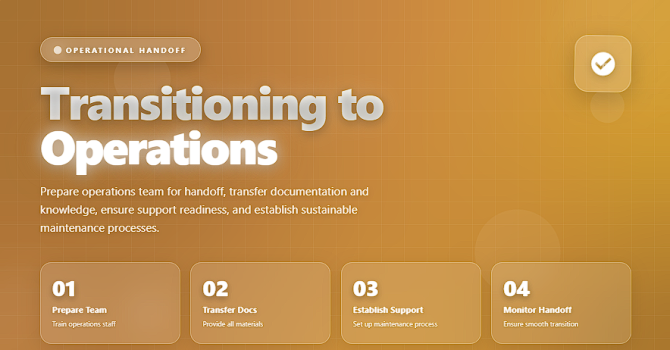
Transitioning to operations is a structured process that bridges the gap between project execution and business-as-usual (BAU). This article explains how project managers can plan, implement, and validate a smooth operational handover.
✅ What Is Transition to Operations?
Transitioning to operations is the process of transferring project deliverables, documentation, knowledge, responsibilities, and support activities from the project team to the operations or business team that will own the product long-term.
It ensures that:
✔️ end-users can work safely with the new system or process
✔️ support teams understand how to maintain it
✔️ business continuity remains uninterrupted
✔️ the organization gets long-term value from the project
Think of it as turning a temporary effort into a sustainable asset.
✅ Why the Transition Phase Matters
Transition is often underestimated, but it directly affects:
✔️ long-term performance
✔️ customer satisfaction
✔️ cost of maintenance
✔️ risk exposure
✔️ operational stability
✔️ return on investment (ROI)
Poor transitions often cause:
❌ increased ticket volume
❌ frequent system outages
❌ hidden defects surfacing after go-live
❌ low adoption rates
❌ dependency on project staff long after closure
A well-planned transition avoids these issues and sets the organization up for success.
✅ Key Components of a Successful Transition to Operations
✔️ 1. Operational Requirements Planning
Transition planning should start early — ideally in the Initiation or Planning phase.
This includes defining:
✔️ performance thresholds
✔️ capacity requirements
✔️ security controls
✔️ backup and recovery needs
✔️ staffing and training requirements
The operations team must agree on these standards before handover.
✔️ 2. Knowledge Transfer Sessions
Operations and support teams require deep understanding of the new system.
Knowledge transfer should include:
✔️ system architecture
✔️ workflow logic
✔️ escalation rules
✔️ maintenance tasks
✔️ troubleshooting steps
✔️ known issues and workarounds
Make knowledge transfer structured, documented, and mandatory.
✔️ 3. Comprehensive Documentation Handover
Documentation is the backbone of stable operations.
Essential documents include:
✔️ technical specifications
✔️ configuration records
✔️ user manuals
✔️ admin guides
✔️ support procedures
✔️ SLA definitions
✔️ change logs
✔️ test results
All documents must be reviewed, approved, and stored in the official repository.
✔️ 4. Training for End-Users and Support Teams
Training ensures the organization can adopt and sustain the deliverable.
Training should be tailored for:
✔️ end-users (how to use it)
✔️ support teams (how to maintain it)
✔️ leadership (how to monitor performance)
Training materials must be accessible and kept up-to-date.
✔️ 5. Defining Support, Escalation, and Maintenance Procedures
A smooth transition requires clear operational structures, such as:
✔️ roles and responsibilities
✔️ Tier 1–Tier 3 support models
✔️ escalation matrices
✔️ issue prioritization rules (P1, P2, P3, P4)
✔️ change management protocols
This prevents chaos after go-live and reduces reliance on the project team.
✔️ 6. Operational Readiness Review (ORR)
Before handover, perform a formal Operational Readiness Review, checking:
✔️ documentation completeness
✔️ system stability
✔️ support preparedness
✔️ resources availability
✔️ risk and issue closure
✔️ performance validation
The ORR confirms whether the system is ready for daily operations.
✔️ 7. Pilot Testing or Soft Launch
A pilot phase reveals real-world issues early without exposing the whole organization.
This is ideal for:
✔️ software rollouts
✔️ process changes
✔️ new equipment deployment
A pilot reduces operational risks before full deployment.
✔️ 8. Go-Live and Hypercare Period
After full implementation, the project team remains temporarily available for:
✔️ post-launch issue resolution
✔️ fine-tuning configurations
✔️ additional user support
✔️ stabilizing performance
Hypercare usually lasts 1–4 weeks, depending on project complexity.
✔️ 9. Final Acceptance and Formal Handover
The handover is complete when:
✔️ operations signs off
✔️ all issues are closed
✔️ support teams confirm readiness
✔️ training is complete
✔️ documentation is verified
This moment officially shifts responsibility from the project team to operations.
✔️ 10. Post-Implementation Review
Evaluate transition success by analyzing:
✔️ adoption rates
✔️ performance results
✔️ support ticket trends
✔️ stakeholder feedback
✔️ operational stability
These insights improve future transitions and strengthen organizational maturity.
⭐ Best Practices for Smooth Transition
✔️ involve operations early
✔️ define acceptance criteria clearly
✔️ standardize templates and documentation
✔️ use checklists for readiness
✔️ avoid last-minute knowledge transfers
✔️ establish strong governance
✔️ maintain transparent communication
✔️ track issues daily during hypercare
Proactive collaboration is the key to seamless operations.
❌ Common Transition Mistakes
Avoid these risks:
❌ treating transition as an afterthought
❌ unclear accountability between teams
❌ lack of proper documentation
❌ insufficient training
❌ ignoring operational constraints
❌ rushing go-live without testing
❌ failing to plan long-term maintenance
A failed transition can undermine an otherwise successful project.
⭐ Final Thoughts
Transitioning to operations is the bridge between delivering a solution and sustaining it long-term.
A strong handover process protects business continuity, empowers teams, reduces operational risks, and maximizes the value of the project.
Projects deliver outputs.
Operations deliver ongoing value.
Transition is the moment that connects the two.