
 MElkhateeb
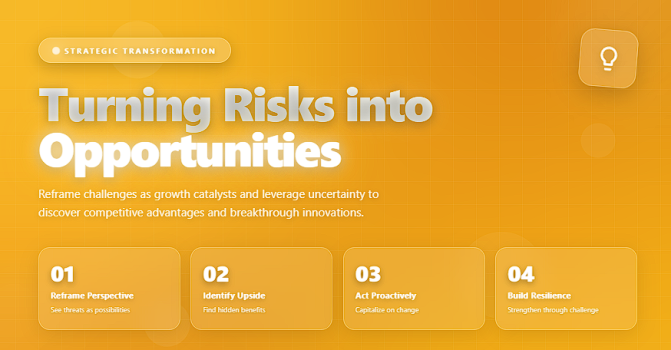
➡️ Introduction
In project management, risks are usually seen as threats — events that could delay timelines, increase costs, or damage quality.
But skilled project managers know something deeper:
Top 5 Project Management Software
Every risk carries the potential for opportunity.
When approached strategically, risks can reveal hidden benefits, innovative solutions, performance improvements, and competitive advantages. Companies that learn to convert risks into opportunities often achieve stronger outcomes, faster delivery, and higher value.
This article teaches you how to identify opportunity-based risks, how to analyze them, and how to integrate them into your project strategy — using practical steps and real PM best practices.
✅ What Does It Mean to Turn Risks into Opportunities?
Not all risks are negative. In project management, risks may be:
- Threats: negative effects if they occur
- Opportunities: positive outcomes if leveraged correctly
Turning risks into opportunities means:
✔️ identifying positive consequences hidden within uncertainties
✔️ reframing risk conversations from defensive to strategic
✔️ exploiting conditions that allow your project to benefit
✔️ using uncertainty as a source of innovation
This mindset elevates a project manager from problem-solver to value creator.
✅ Examples of Opportunities Hidden in Risks
Here are typical scenarios where risks can become advantages:
- A delay in materials allows time to implement a better design
- A new regulatory requirement leads to improved quality standards
- A resource shortage encourages automation and efficiency
- A competitor’s failure opens market space for your product
- A technical challenge pushes the team to create an innovative solution
Risk is often the doorway to improvement — if recognized early.
✅ Types of Opportunity-Based Risks
Positive risks that can increase value, speed, or performance.
| Opportunity Type | Description | Examples |
|---|---|---|
| Efficiency Opportunity | Occurs when a challenge leads to improved workflows or automation. | Automating manual tasks due to resource shortage. |
| Cost-Saving Opportunity | A risk opens a path to reducing operational or delivery costs. | Supplier changes result in discounted pricing. |
| Innovation Opportunity | Technical barriers push the team to invent new solutions. | System limitations lead to creation of a custom tool. |
| Market Opportunity | External risks expose new customer or market potential. | Competitor delays open demand for your product. |
| Strategic Opportunity | Risks reveal areas where the company can strengthen strategic position. | Regulatory changes create higher barriers for competitors. |
✅ How to Turn Risks Into Opportunities (Step-by-Step)
✔️ 1. Start by Identifying Positive Risks
Positive risks are often ignored because teams focus on threats.
Use these questions:
- What good could happen unexpectedly?
- What advantages could arise from delays or resource changes?
- What opportunities could technology limitations reveal?
✔️ 2. Classify the Opportunity
Opportunities fall into categories like:
✔️ time savings
✔️ cost reduction
✔️ performance improvement
✔️ innovation
✔️ customer satisfaction increase
This classification helps with prioritization.
✔️ 3. Assess Probability and Benefit
Similar to risk assessment:
- Probability: likelihood of the opportunity occurring
- Impact/Benefit: how valuable it would be
High-benefit, high-probability opportunities should be exploited immediately.
✔️ 4. Develop Opportunity Response Strategies
The PMBOK recognizes four opportunity responses:
✔️ Exploit – Ensure the opportunity definitely occurs
✔️ Enhance – Increase the probability or impact
✔️ Share – Partner with stakeholders to maximize the benefit
✔️ Accept – Take advantage if it happens
This is the mirror image of threat responses.
✔️ 5. Integrate Opportunities into the Risk Register
Opportunities must be recorded with:
- description
- triggers
- owner
- planned actions
- potential benefits
This ensures visibility and accountability.
✔️ 6. Communicate Opportunities to Stakeholders
Opportunities should be included in:
✔️ status reports
✔️ steering committee updates
✔️ sprint reviews
✔️ management summaries
Stakeholders value seeing upside potential, not just threats.
✔️ 7. Monitor Opportunity Triggers
Just like threat triggers, opportunity triggers help you act at the right time.
Examples:
- early delivery of components
- faster approvals
- lower resource utilization
- budget underspend
Monitoring ensures you don’t miss the moment to exploit the opportunity.
❌ Common Mistakes to Avoid
❌ Treating all risks as negative
❌ Not recording opportunities formally
❌ Ignoring small opportunities that compound into big wins
❌ Missing the right timing to exploit an opportunity
❌ Focusing only on reactive problem-solving
⭐ Best Practices
✔️ Train teams to adopt a positive-risk mindset
✔️ Use visual dashboards to track opportunities
✔️ Celebrate opportunity wins to reinforce behavior
✔️ Integrate opportunity planning into your risk management strategy
✔️ Always ask: “Where is the hidden advantage?”
⭐ Final Thoughts
Risks are not only threats — they are windows to innovation and growth.
Project managers who learn to convert risks into opportunities contribute far more than task management:
they deliver strategic value, competitive advantage, and future readiness.
Great PMs don’t just survive uncertainty —
they turn it into progress.