 MElkhateeb
➡️ Introduction
Accurate time and cost estimation is one of the biggest challenges in project management. Many projects fail not because of poor execution, but because they start with unrealistic schedules and budgets.
Top 5 Project Management Software
This is where the Work Breakdown Structure (WBS) becomes a powerful planning tool.
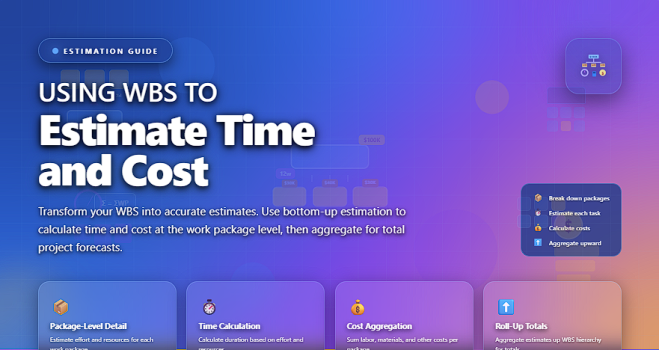
By breaking the project into smaller, manageable components, the WBS enables project managers to estimate time and cost more accurately, reduce uncertainty, and improve control.
In this article, you’ll learn how to use a WBS step-by-step to estimate both time and cost, and why experienced project managers rely on it as the foundation of reliable planning.
✅ Why WBS Is Critical for Estimation
Estimating directly at the project level almost always leads to errors.
The WBS solves this by:
✔️ Breaking complex work into manageable pieces
✔️ Making hidden activities visible
✔️ Improving accuracy of effort estimation
✔️ Supporting realistic budgeting
✔️ Reducing overlooked tasks
✔️ Creating traceability between scope, time, and cost
In short:
If your WBS is weak, your estimates will be weak.
✅ How WBS Improves Time & Cost Estimation
Linking scope breakdown to realistic planning outcomes.
| WBS Element | How It Helps Time Estimation | How It Helps Cost Estimation |
|---|---|---|
| Work Packages | Allow accurate task-level duration estimates. | Enable detailed labor and resource costing. |
| Defined Scope | Prevents missing activities in the schedule. | Eliminates unplanned expenses. |
| Clear Deliverables | Improves sequencing and dependencies. | Aligns budget with tangible outputs. |
| Activity Breakdown | Supports realistic duration estimation methods. | Improves accuracy of material and effort costs. |
| Ownership Assignment | Improves accountability for timelines. | Clarifies responsibility for cost control. |
✅ Step-by-Step: Estimating Time Using WBS
✔️ 1. Break Work into Work Packages
Each work package should be small enough to estimate confidently.
A good rule:
✅ 1–2 weeks of work maximum per package
✔️ 2. Identify Activities for Each Package
Convert each work package into activities that can be scheduled.
This prevents hidden or forgotten tasks.
✔️ 3. Estimate Durations at the Activity Level
Use techniques such as:
✔️ Expert judgment
✔️ Historical data
✔️ Three-point estimating
✔️ Analogous estimating
Smaller tasks = higher accuracy.
✔️ 4. Sequence Activities and Build the Schedule
Once estimated, activities are linked to create a realistic timeline.
✅ Step-by-Step: Estimating Cost Using WBS
✔️ 1. Assign Resources to Each Work Package
Resources may include:
✔️ Labor
✔️ Materials
✔️ Equipment
✔️ Software
✔️ External services
✔️ 2. Estimate Cost at the Lowest Level
Costs are estimated per work package, not per project.
This reduces guessing and improves transparency.
✔️ 3. Roll Up Costs to Higher Levels
Work package costs are summed up to:
✔️ deliverable level
✔️ phase level
✔️ total project budget
This creates a defensible cost baseline.
✔️ 4. Add Contingency and Reserves
Once WBS-based estimates are complete, contingency buffers can be applied intelligently.
✅ Common Mistakes to Avoid
❌ Estimating at too high a level
❌ Skipping small tasks
❌ Using WBS only for scope, not estimation
❌ Ignoring indirect costs
❌ Failing to update estimates as WBS evolves
✅ Best Practices
✔️ Always estimate from the bottom up
✔️ Keep work packages manageable
✔️ Involve the team in estimation
✔️ Use historical data where possible
✔️ Align WBS, schedule, and budget together
✔️ Update estimates when scope changes
⭐ Final Thoughts
The Work Breakdown Structure is more than a scope document — it is the foundation of accurate time and cost estimation.
When used correctly, it transforms planning from guesswork into a structured, reliable process that builds confidence with stakeholders and protects the project from avoidable failure.
Great estimates start with a great WBS.