 MElkhateeb
➡️ Introduction
When planning goes wrong, projects rarely fail all at once.
They fail quietly, gradually, and predictably.
Top 5 Project Management Software
At first, issues seem small: a slipped task, an unclear dependency, a minor assumption. Over time, these gaps compound. Teams work harder, meetings increase, and confidence erodes — until delivery becomes reactive instead of controlled.
Planning failure is not about bad intent or weak effort.
It is about decisions made with incomplete structure.
This article explains what actually happens when planning goes wrong, how the effects unfold, and why early planning discipline is the most reliable form of risk management.
✅ What “Planning Gone Wrong” Really Means
Poor planning does not always look like no planning.
More often, it looks like:
✔️ optimistic assumptions treated as commitments
✔️ detailed task lists without clear dependencies
✔️ dates assigned before capacity is confirmed
✔️ plans created once and never revisited
✔️ risks documented but not managed
The plan exists — but it does not reflect reality.
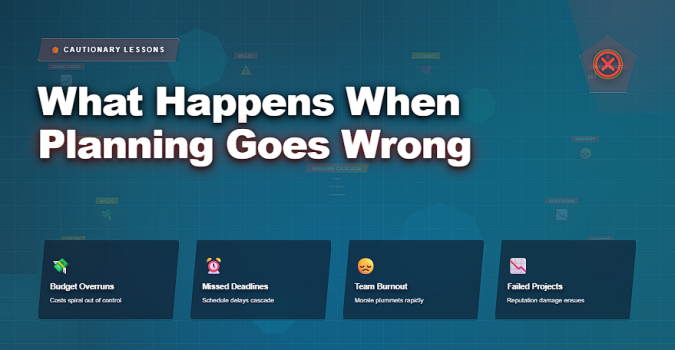
❌ Consequences of Poor Project Planning
How early planning gaps become late-stage failures.
| Planning Issue | What Happens | Project Impact |
|---|---|---|
| Unclear Dependencies | Tasks start before prerequisites are ready | Rework and idle time |
| Optimistic Estimates | Milestones slip early | Loss of schedule credibility |
| No Capacity Planning | Key people overloaded | Burnout and bottlenecks |
| Weak Risk Planning | Issues treated as surprises | Reactive firefighting |
| Static Plans | Reality diverges from the plan | Late recovery and escalation |
✅ How Teams React When Planning Fails
As control weakens, teams often respond with:
✔️ longer meetings
✔️ more reporting
✔️ added overtime
✔️ compressed testing
✔️ informal prioritization
These actions increase effort — but not predictability.
❌ Why Recovery Becomes So Difficult
Once planning fails:
✔️ trust in dates disappears
✔️ decisions become emotional
✔️ stakeholders push harder
✔️ teams hide bad news
✔️ options shrink rapidly
Late-stage recovery is always more expensive than early planning discipline.
⭐ Early Warning Signs Planning Is Failing
Project managers should watch for:
✔️ frequent re-baselining
✔️ missed internal milestones
✔️ vague status updates
✔️ repeated dependency issues
✔️ “almost done” tasks lasting weeks
These signals appear long before formal failure.
⭐ What Strong PMs Do Differently
Strong project managers:
✔️ challenge assumptions early
✔️ plan around capacity, not hope
✔️ make dependencies visible
✔️ re-plan proactively
✔️ treat planning as ongoing control
Planning is not a document — it is a behavior.
⭐ Final Thoughts
When planning goes wrong, execution pays the price.
Projects do not collapse because teams lack skill or commitment.
They collapse because structure is missing where decisions should be.
Successful projects are not built on perfect plans —
but on realistic, adaptable, and actively managed ones.