 MElkhateeb
➡️ Introduction
In today’s fast-moving business world, success rarely happens by chance. Behind every product launch, infrastructure build, or digital transformation stands one key discipline — project management. Whether it’s constructing a hospital, developing new software, or organizing a global marketing campaign, project management ensures that teams stay on track, within budget, and aligned with strategic goals.
Top 5 Project Management Software
This article explains what project management is, explores its core components, and highlights why it matters in modern organizations. We’ll also look at how it contributes to productivity, profitability, and long-term growth — and how you can start developing strong project management skills today.
✅ What Is Project Management?
Project management is the structured process of planning, organizing, and controlling resources to achieve specific objectives within a defined scope, time, and budget. It provides a repeatable framework for guiding projects from start to finish — balancing constraints such as time, cost, and quality, often called the triple constraint or iron triangle.
In simple terms, it’s about turning ideas into results. Project management transforms strategic visions into actionable plans and ensures accountability at every step.
☑️ Core Elements of Project Management
- Scope – Defines what the project will (and will not) deliver.
- Time – The schedule for completing tasks and milestones.
- Cost – The total budget, including people, materials, and tools.
- Quality – Standards that deliver value to stakeholders.
- Resources – Allocation of human and material assets.
- Risk – Identification and mitigation of uncertainties.
- Communication – Coordination between stakeholders and teams.
Together, these elements help ensure a project’s success through continuous monitoring, control, and adaptation.
✅ The Project Management Lifecycle
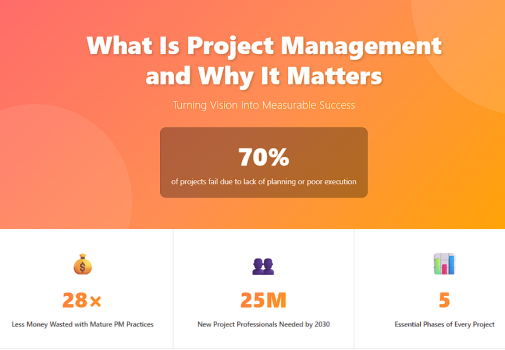
Every project follows a structured journey called the project management lifecycle, typically divided into five stages:
- Initiation – Defining objectives, stakeholders, and feasibility.
- Planning – Outlining scope, timelines, budgets, and risk strategies.
- Execution – Performing the planned work and managing teams.
- Monitoring & Controlling – Tracking progress, managing changes, and maintaining quality.
- Closing – Delivering final outputs, obtaining approvals, and documenting lessons learned.
This process provides a systematic roadmap that helps organizations replicate success across multiple initiatives.
✅ Why Project Management Matters
Project management is much more than scheduling tasks — it’s about strategic value creation.
☑️ 1. Aligns Work with Business Goals
Projects should support the company’s mission and vision. A skilled project manager ensures that daily operations align with larger strategic objectives, preventing wasted effort and resources.
☑️ 2. Improves Efficiency and Productivity
By using structured methodologies such as Agile, Scrum, or Waterfall, teams can collaborate efficiently, reduce rework, and deliver faster without compromising quality.
☑️ 3. Minimizes Risks
Every project involves uncertainty — scope creep, cost overruns, delays. Effective project management anticipates and mitigates these risks before they impact outcomes.
☑️ 4. Enhances Communication
Clear communication builds trust and alignment among stakeholders. A strong project manager ensures transparency through progress reports, dashboards, and status meetings.
☑️ 5. Controls Costs and Resources
Budget control is central to successful delivery. Through careful planning and forecasting, project management prevents overspending and optimizes resource utilization.
☑️ 6. Increases Customer and Stakeholder Satisfaction
When projects meet requirements on time and within scope, stakeholders gain confidence in the organization’s capabilities, leading to repeat business and stronger partnerships.
☑️ 7. Enables Continuous Improvement
Post-project reviews and lessons learned drive improvement in processes, team performance, and overall organizational maturity.
✅ Modern Project Management: Tools and Technologies
Today’s project managers rely on advanced software to handle complexity and collaboration across distributed teams. Popular platforms include:
- Miro – For visual planning, brainstorming, and sprint retrospectives.
- Monday.com – For project tracking and automation.
- ClickUp – For managing workflows and productivity metrics.
- Asana – For task management and team collaboration.
- Microsoft Project – For detailed scheduling and resource management.
These tools integrate with analytics and AI to predict risks, track performance, and automate repetitive work — freeing managers to focus on decision-making and leadership.
✅ The Role of a Project Manager
A project manager (PM) acts as the link between leadership vision and the execution team. Their responsibilities include:
- Defining project goals and deliverables.
- Developing and maintaining the project plan.
- Managing stakeholders and communication.
- Controlling scope, schedule, and budget.
- Leading and motivating teams.
- Handling risks and issues proactively.
Successful PMs combine technical expertise with emotional intelligence, negotiation, and leadership — skills increasingly vital in hybrid and remote work environments.
✅ Common Project Management Methodologies
Different industries and projects require different approaches. Some of the most recognized frameworks include:
- Waterfall: Sequential process ideal for construction and manufacturing.
- Agile: Iterative, flexible method for software and innovation projects.
- Scrum: Agile framework emphasizing short sprints and team collaboration.
- Kanban: Visual task management focused on continuous flow.
- Lean: Focused on reducing waste and maximizing value.
- Six Sigma: Data-driven method for improving quality and reducing defects.
- Hybrid: Combination of multiple methodologies tailored to project needs.
Understanding these approaches helps teams select the best system for their context and goals.
✅ Why Organizations Can’t Afford Poor Project Management
According to the Project Management Institute (PMI), organizations waste around 12% of project investment due to poor performance — billions lost annually. The absence of structured project management leads to:
- Missed deadlines and escalating costs.
- Confused accountability and weak communication.
- Demotivated teams and project burnout.
- Loss of customer trust and reputation.
In contrast, mature organizations with strong project management cultures achieve better ROI, improved innovation rates, and stronger stakeholder engagement.
✅ How to Develop Project Management Skills
Whether you’re a beginner or an experienced professional, you can strengthen your project management foundation through:
- Formal Training: Professional certificates such as Google Project Management, PMI-PMP, or CAPM.
- Practical Experience: Leading small internal projects or volunteering for cross-functional initiatives.
- Mentorship: Learning from seasoned project leaders.
- Software Proficiency: Familiarity with tools like Monday.com, Miro, and ClickUp.
- Continuous Learning: Staying updated on trends like Agile, AI-driven planning, and sustainability in projects.
These steps can accelerate your career growth and open doors to leadership opportunities across industries.
✅ Final Thoughts
Project management isn’t just about Gantt charts or deadlines — it’s the engine of organizational success. It turns strategies into results, reduces waste, enhances collaboration, and empowers innovation.
As global markets become more dynamic, strong project management is no longer optional — it’s a competitive necessity. By mastering its principles, adopting modern tools, and nurturing leadership skills, individuals and organizations alike can deliver consistent value and long-term impact.