 MElkhateeb
➡️ Introduction
Every project carries uncertainty — changing requirements, resource shortages, technical issues, supplier delays, or unexpected events. These uncertainties become risks, and if they’re not managed, they can derail timelines, increase costs, or reduce quality.
Top 5 Project Management Software
This is why Project Risk Management is one of the most essential components of professional project management.
It ensures that you identify potential problems before they happen, evaluate their impact, and take action to prevent or reduce them.
In simple terms:
Risk Management helps you protect the project from surprises and keep everything under control.
✅ What Is Project Risk Management?
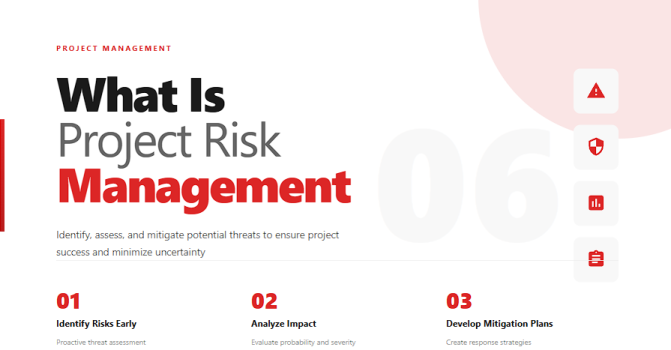
Project Risk Management is the structured process of identifying, analyzing, prioritizing, and responding to risks that may impact project objectives.
It includes:
✔️ Recognizing potential issues early
✔️ Assessing how likely they are to happen
✔️ Understanding how severe the impact would be
✔️ Developing strategies to reduce or avoid them
✔️ Monitoring risks continuously
✔️ Taking action if a risk becomes a real issue
Risk management does NOT eliminate risk — it prepares your project for it.
✅ Key Components of Risk Management
✅ Core Components of Project Risk Management
A structured framework for identifying, analyzing, and responding to risks.
| Component | Why It Matters | How It Works |
|---|---|---|
| 1. Risk Identification | Prevents surprises by listing potential threats early. | Brainstorm risks, review past projects, and interview stakeholders. |
| 2. Risk Analysis | Determines which risks need urgent attention. | Evaluate likelihood, impact, and assign priority scores. |
| 3. Risk Response Planning | Creates a proactive plan to reduce or eliminate threats. | Define mitigation, avoidance, transfer, or acceptance strategies. |
| 4. Risk Monitoring | Tracks risks over time and ensures timely action. | Review risks in weekly meetings and update the risk register. |
| 5. Risk Communication | Ensures stakeholders stay informed and aligned. | Share updates in dashboards, status reports, and briefings. |
✅ The Risk Management Process (Step-by-Step)
✔️ 1. Identify Risks
Use tools like:
- brainstorming
- SWOT analysis
- checklists
- expert interviews
- historical lessons learned
Document everything in a Risk Register.
✔️ 2. Analyze Risks
Evaluate each risk based on:
- Likelihood (How likely is it to happen?)
- Impact (If it happens, how bad is it?)
This helps you focus on the most critical risks first.
✔️ 3. Prioritize Risks
Use techniques like:
- Probability & Impact Matrix
- Risk scoring
- Heat maps
High-impact, high-probability risks are your top priority.
✔️ 4. Plan Risk Responses
Four main response strategies:
✔️ Avoid — remove the risk entirely
✔️ Mitigate — reduce likelihood or impact
✔️ Transfer — move responsibility (e.g., contracts or insurance)
✔️ Accept — recognize the risk and monitor it
✔️ 5. Monitor & Control
Track risks continuously through:
- weekly reviews
- dashboards
- trigger conditions
- issue logs
Risk management is an ongoing process — not a one-time step.
🛠️ Tools That Support Risk Management
✔️ Miro – Visual mapping of risks and mitigation plans
✔️ Monday.com – Risk tracking boards and automation
✔️ Smartsheet – Risk registers and dashboards
✔️ Power BI – Risk heat maps and analytics
✔️ Excel/Google Sheets – Simple risk register templates
❌ Common Mistakes to Avoid
❌ Identifying risks only at the beginning of the project
❌ Not involving the team in risk discussions
❌ Underestimating “small” risks
❌ Confusing risks with issues
❌ Failing to assign risk owners
❌ No follow-up after creating the risk register
⭐ Best Practices
✔️ Involve all departments in risk workshops
✔️ Use visuals: heat maps, matrices, charts
✔️ Assign a dedicated owner for every risk
✔️ Track risks weekly — not monthly
✔️ Celebrate effective mitigation
✔️ Update risks as the project evolves
⭐ Final Thoughts
Project Risk Management is not about predicting the future — it’s about being prepared.
With structured risk management, you reduce uncertainty, protect the project, and make better decisions.
Great project managers don’t eliminate risk — they manage it strategically.