 MElkhateeb
➡️ Introduction
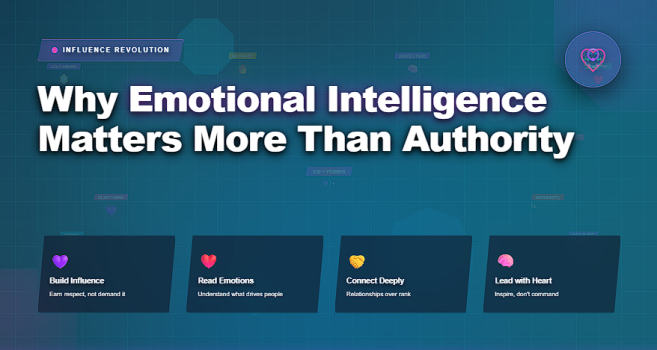
Authority can make people comply.
Emotional intelligence makes people commit.
Top 5 Project Management Software
In modern teams, leadership effectiveness is no longer determined by title, hierarchy, or decision rights alone. Knowledge workers expect respect, clarity, and psychological safety — not command-and-control behavior.
Leaders who rely primarily on authority often achieve short-term obedience, but struggle with trust, engagement, and sustainability. Leaders with high emotional intelligence, however, create environments where people choose to perform at their best.
This article explains why emotional intelligence matters more than authority, how it shows up in real leadership situations, and why it has become one of the strongest predictors of long-term leadership success.
✅ What Emotional Intelligence Really Means in Leadership
Emotional intelligence (EI) in leadership is the ability to recognize, understand, and manage emotions — both your own and those of others — to guide behavior and decisions effectively.
In practice, emotionally intelligent leaders:
✔️ regulate their reactions under pressure
✔️ listen before responding
✔️ recognize team stress and motivation
✔️ adapt communication style
✔️ build trust through consistency
EI is not about being “nice.”
It is about being effective with people.
✅ Why Authority Alone Is No Longer Enough
Authority relies on:
✔️ formal power
✔️ job titles
✔️ escalation paths
✔️ compliance mechanisms
But modern work environments are:
✔️ collaborative
✔️ cross-functional
✔️ fast-changing
✔️ knowledge-driven
In these conditions, authority without emotional intelligence often results in:
❌ resistance instead of alignment
❌ silence instead of feedback
❌ disengagement instead of ownership
People may follow instructions — but they stop contributing their best thinking.
✅ Emotional Intelligence vs. Authority
How leadership approach impacts behavior and results.
| Leadership Aspect | Authority-Driven | Emotionally Intelligent |
|---|---|---|
| Decision Acceptance | Based on compliance | Based on understanding and trust |
| Communication Style | One-way, directive | Two-way, adaptive |
| Conflict Handling | Suppressed or escalated | Addressed constructively |
| Team Motivation | Extrinsic and short-term | Intrinsic and sustainable |
| Trust Level | Conditional | Consistent and durable |
✅ How Emotional Intelligence Improves Leadership Outcomes
Leaders with strong emotional intelligence:
✔️ surface risks earlier
✔️ reduce defensive behavior
✔️ improve collaboration
✔️ increase psychological safety
✔️ maintain performance under stress
EI turns leadership from control into influence.
❌ Common Mistakes Leaders Make with Authority
❌ assuming title equals respect
❌ using pressure instead of clarity
❌ ignoring emotional signals
❌ dismissing concerns as resistance
❌ confusing firmness with rigidity
Authority can silence issues — but it cannot solve them.
⭐ How Leaders Can Build Emotional Intelligence
Emotional intelligence is a skill, not a trait.
Leaders can develop it by:
✔️ practicing self-awareness
✔️ pausing before reacting
✔️ seeking feedback regularly
✔️ listening without interrupting
✔️ reflecting after difficult conversations
Small habits create significant leadership impact.
⭐ A Simple Self-Check for Leaders
Ask yourself:
✔️ Do people feel safe sharing bad news with me?
✔️ How do I react when challenged?
✔️ Do I adjust my approach based on emotional context?
The answers reveal where influence truly comes from.
⭐ Final Thoughts
Authority can command attention.
Emotional intelligence earns trust.
In modern leadership — especially in project environments — influence matters more than control, and trust matters more than titles.
Leaders who master emotional intelligence do not lose authority.
They transcend it — and create teams that follow willingly, think freely, and perform consistently.