 MElkhateeb
➡️ Introduction
Modern leaders face a world of complexity—fast-moving markets, cross-functional teams, digital disruption, and growing pressure to deliver results with fewer resources.
In this environment, leadership alone is not enough.
Top 5 Project Management Software
The most successful leaders share one hidden advantage:
They understand the fundamentals of project management.
PM skills help leaders plan clearly, align teams, manage risks, communicate effectively, and deliver consistent outcomes. Whether you’re a CEO, department head, team supervisor, or entrepreneur, project management turns your ideas into real, measurable results.
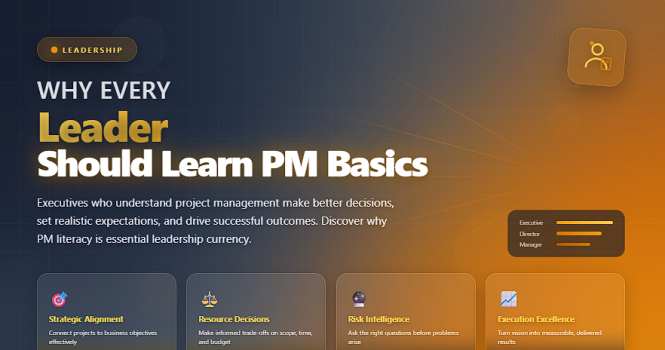
This article explains why PM basics are essential for every leader, and how these skills elevate decision-making, clarity, and long-term performance.
✅ The Link Between Leadership and Project Management
Leadership focuses on vision, people, and motivation.
Project management focuses on structure, execution, and measurable results.
When combined, leaders gain powerful capabilities:
✔️ Clear goals
✔️ Strong communication
✔️ Efficient workflows
✔️ Controlled risks
✔️ Repeatable success
Below is a responsive table showing how PM skills strengthen leadership performance.
✅ How PM Skills Strengthen Leadership
A structured view of why PM foundations matter for leaders.
| Leadership Need | PM Skill Contribution | Result |
|---|---|---|
| Clarity of Direction | Defines scope, objectives, and success criteria. | Teams understand purpose and priorities. |
| Efficient Execution | Schedules, workflows, and milestones. | Faster delivery with fewer delays. |
| Risk Awareness | Identifies risks and prepares response plans. | Leaders avoid surprises and protect resources. |
| Communication | Stakeholder mapping and communication plans. | Consistent alignment and transparency. |
| Accountability | Role assignments, RACI charts, and tracking. | Everyone knows their responsibilities. |
✅ Why Every Leader Should Learn Project Management Basics
✔️ 1. PM Helps Leaders Set Clear and Achievable Goals
Project management teaches leaders how to define:
- SMART objectives
- measurable outcomes
- realistic timelines
- clear scope boundaries
Leaders who use PM methods avoid ambiguity and create direction that teams can confidently follow.
✔️ 2. PM Enhances Strategic Planning
Project managers use tools such as:
- work breakdown structures
- critical path analysis
- risk registers
- resource plans
These tools help leaders anticipate constraints and make strategic decisions based on data—not assumptions.
✔️ 3. PM Builds Stronger Communication Channels
Leaders who understand PM basics can:
✔️ build communication plans
✔️ establish update cycles
✔️ communicate status more clearly
✔️ align cross-functional teams
Teams perform better when information flows smoothly and consistently.
✔️ 4. PM Improves Risk Management
Leaders trained in PM identify risks early, assess them properly, and respond with planned strategies rather than reactive fixes.
This prevents crises and protects the organization from unnecessary cost, delays, or reputational damage.
✔️ 5. PM Strengthens Team Accountability
Using PM frameworks such as RACI charts and task management tools, leaders can define roles clearly and eliminate confusion.
This builds discipline, ownership, and follow-through.
✔️ 6. PM Helps Leaders Deliver Predictable Results
Without PM principles, even talented teams struggle to deliver consistently.
PM fundamentals help leaders:
✔️ forecast accurately
✔️ measure progress
✔️ control scope
✔️ adapt to change professionally
Predictability becomes a competitive advantage.
✔️ 7. PM Drives Continuous Improvement
Project management encourages lessons learned, retrospectives, and iterative improvement.
Leaders who apply these practices build resilient, learning-driven teams.
✔️ 8. PM Skills Make Leaders More Valuable
Executives increasingly expect leaders to manage both people and projects.
PM skills expand leadership capability, improve decision-making, and open new career growth paths.
⭐ Final Thoughts
Project management isn’t just for project managers—it’s an essential leadership tool.
Leaders who master PM basics become more strategic, more organized, and more capable of driving meaningful results.
They communicate better, manage risks proactively, and build teams that deliver consistently—even in uncertain environments.
In today’s world, the strongest leaders are those who combine vision with execution—and project management is the bridge between them.