 MElkhateeb
➡️ Introduction
Every successful project—whether small or large, traditional or Agile—begins with one core ingredient: a clear and strategic plan.
Planning is not paperwork, nor is it optional. It is the foundation that gives purpose, direction, and structure to all project work.
Top 5 Project Management Software
A strong plan helps:
✔️ align stakeholders
✔️ prevent resource waste
✔️ set realistic expectations
✔️ clarify roles and responsibilities
✔️ guide decision-making
✔️ reduce risks
✔️ enable predictable execution
When planning is weak or skipped, even skilled teams fail. When planning is strong, risks are controlled, teams stay focused, and success becomes measurable and repeatable.
This article explains why planning matters, what it provides, and how it drives project success across the entire lifecycle.
✅ What Planning Really Means in Project Management
Planning is more than creating a schedule—it is the process of:
✔️ defining what must be done
✔️ determining how it will be done
✔️ identifying when it must happen
✔️ selecting who will do the work
✔️ understanding why it matters
✔️ preparing for what could go wrong
Planning provides a roadmap, a shared understanding, and a structured way of working.
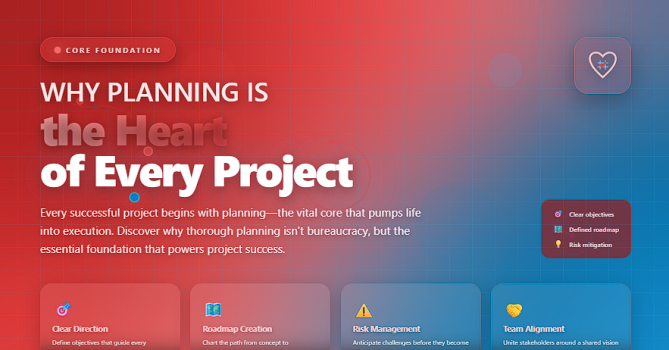
✅ Why Planning Is the Heart of Every Project
Below are the fundamental reasons planning is the core of project success.
✔️ 1. Planning Clarifies Project Goals
A project without a goal is like a ship without a compass.
Planning defines:
- What the project must deliver
- What outcomes matter most
- What “success” looks like for stakeholders
Clear goals = clear direction.
✔️ 2. Planning Aligns Stakeholder Expectations
Stakeholders often have different assumptions.
A strong plan ensures everyone agrees on:
- Scope
- Timeline
- Budget
- Priorities
- Risks
- Success criteria
Alignment early prevents conflict later.
✔️ 3. Planning Helps Identify and Control Risks
Most project failures come from unmanaged risks.
Planning allows teams to:
- spot future threats
- analyze probability & impact
- assign owners
- create mitigation strategies
- prepare contingency actions
Planning = prevention + preparation.
✔️ 4. Planning Improves Resource Management
Every project depends on limited resources such as:
- people
- budget
- materials
- tools
- technology
Planning helps allocate resources smartly and prevents overload, bottlenecks, and burnout.
✔️ 5. Planning Enables Accurate Scheduling
The schedule is the rhythm of the project.
Good planning determines:
- task dependencies
- duration estimates
- milestones
- critical path
- deadlines
Planning ensures time is realistic—not guessed.
✔️ 6. Planning Strengthens Communication
Teams communicate better when they know:
- what must be done
- when it must be done
- who owns each task
- how progress will be measured
- how changes will be handled
Planning creates transparency and avoids miscommunication.
✔️ 7. Planning Builds Team Confidence
Clear plans create motivated teams.
When people understand expectations, they feel:
✔️ empowered
✔️ confident
✔️ accountable
✔️ aligned
Teams perform at their best when direction is solid.
✔️ 8. Planning Is the Foundation for Monitoring & Control
Without a plan, you cannot measure:
- progress
- variances
- performance
- changes
- risks
Planning is the baseline from which all control decisions are made.
✅ Key Components of a Strong Project Plan
Core elements required to guide execution and control.
| Element | Description | Purpose |
|---|---|---|
| Project Scope | Defines boundaries, deliverables, and exclusions. | Prevents scope creep and misalignment. |
| Schedule | Lists tasks, milestones, dependencies, deadlines. | Creates the project timeline. |
| Budget | Estimated costs and financial constraints. | Controls spending and resource allocation. |
| Risk Management Plan | How risks will be identified, monitored, and mitigated. | Prepares the team for uncertainty. |
| Communication Plan | Defines frequency, channels, and audiences. | Ensures clear communication across stakeholders. |
| Quality Plan | Standards, acceptance criteria, and QA processes. | Ensures high-quality outputs. |
⭐ Final Thoughts
Planning is not the first step of project management—it is the core that holds everything together.
Strong planning produces clarity, focus, efficiency, and control. Weak planning guarantees confusion, delays, and rework.
If execution is the engine of a project,
planning is the fuel that makes the engine run.