 MElkhateeb
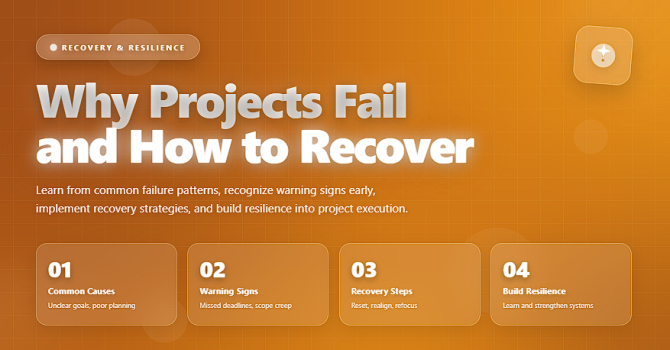
➡️ Introduction
Every project begins with ambition — clear goals, motivated teams, and high expectations. But despite the best intentions, studies consistently show that a significant percentage of projects fail due to issues like unclear requirements, poor communication, unrealistic deadlines, shifting priorities, or lack of stakeholder alignment.
Top 5 Project Management Software
Project failure does not always mean the end.
The most experienced project managers understand that setbacks can be corrected, redirected, and even transformed into strategic wins.
This article explains why projects fail, how to detect trouble early, and — most importantly — how to recover quickly and effectively.
✅ Why Projects Fail: The Most Common Causes
✔️ 1. Unclear or Changing Requirements
When scope is vague or constantly shifting, the team loses direction, leading to delays, rework, and frustration.
Root cause: lack of early alignment and weak change management.
✔️ 2. Poor Communication
Misunderstandings, unclear expectations, and missing updates lead to misalignment.
Impact: teams work on outdated information and mistakes multiply.
✔️ 3. Unrealistic Deadlines
When timelines are imposed without proper planning, burnout, low quality, and missed targets become inevitable.
Impact: schedule collapses and morale drops.
✔️ 4. Insufficient Resources
Projects fail when they lack skilled people, tools, or budget.
Signs: overloaded team members, task delays, and poor-quality outputs.
✔️ 5. Weak Risk Management
Ignoring risks means issues appear suddenly — and often at the worst time.
Impact: unexpected delays, extra costs, and chaotic firefighting.
✔️ 6. Lack of Stakeholder Engagement
Uninformed or disengaged stakeholders raise objections late or fail to support decisions.
Impact: approvals get delayed and priorities shift without notice.
✔️ 7. Ineffective Leadership
A project manager who cannot lead, influence, or resolve conflicts will struggle to guide the team.
Impact: confusion, misalignment, and low accountability.
✔️ 8. Poor Quality Control
Skipping reviews, checklists, or testing leads to defects and expensive rework.
Impact: delays, client dissatisfaction, and reduced trust.
✔️ 9. Weak Project Planning
Superficial or rushed planning results in incorrect estimates, missing dependencies, and unrealistic expectations.
Impact: constant surprises and schedule instability.
✔️ 10. Organizational Change
Mergers, restructuring, new priorities, or leadership changes often disrupt projects.
Impact: loss of direction, budget cuts, or scope changes.
✅ Early Warning Signs Your Project Is Failing
Experienced project managers watch for the signals of trouble long before the project collapses:
✔️ repeated missed deadlines
✔️ growing backlog of issues
✔️ unclear owner responsibilities
✔️ rising team frustration
✔️ negative feedback from stakeholders
✔️ unapproved scope changes
✔️ declining quality
✔️ poor meeting attendance
✔️ little or no documentation
If multiple symptoms appear — the project is already drifting into trouble.
✅ How to Recover a Project That’s Off Track
⭐ Step 1: Stop the Bleeding
Before taking corrective action, freeze non-critical work.
This prevents further damage while you diagnose the situation.
⭐ Step 2: Conduct a Root Cause Assessment
Interview team members, analyze data, and review documents to identify why performance is slipping.
Focus on facts — not blame.
Key questions:
- What specifically is causing delays?
- Where are we losing efficiency?
- What obstacles are blocking progress?
- What assumptions were incorrect?
⭐ Step 3: Re-Baseline the Project
Update the plan with realistic timelines, resources, costs, and scope.
A new baseline gives stakeholders clarity and resets expectations.
⭐ Step 4: Strengthen Communication
Introduce structured communication habits such as:
✔️ weekly steering committee updates
✔️ daily team checkpoints
✔️ documented decision logs
✔️ clear escalation paths
Clarity reduces frustration and improves alignment instantly.
⭐ Step 5: Re-Engage Stakeholders
Bring sponsors and key stakeholders back into the loop:
✔️ present facts clearly
✔️ share options
✔️ explain risks
✔️ obtain renewed approval
Without alignment at the top, recovery won’t succeed.
⭐ Step 6: Implement Strong Issue and Risk Controls
Convert all current problems into:
✔️ documented issues
✔️ assigned owners
✔️ defined due dates
And ensure all future risks have:
✔️ triggers
✔️ mitigation actions
✔️ owners
Proactive control prevents repeated failures.
⭐ Step 7: Improve Resource Allocation
Reassign tasks, onboard new resources, or adjust workload distribution to remove bottlenecks.
Efficiency rises when people work on tasks suited to their strengths.
⭐ Step 8: Increase Quality Checks
Add:
✔️ peer reviews
✔️ test cycles
✔️ checklists
✔️ validation sessions
Quality improvements reduce rework and rebuild stakeholder confidence.
⭐ Step 9: Introduce Quick Wins
Small, fast successes:
✔️ rebuild team morale
✔️ restore sponsor trust
✔️ create momentum
Quick wins prove that recovery is working.
⭐ Step 10: Document Lessons and Reinforce Discipline
After stabilizing the project, create a short lessons-learned summary to prevent repeating the same issues.
Focus on:
✔️ communication gaps
✔️ planning weaknesses
✔️ decision delays
✔️ unrealistic assumptions
A mature project manager always closes recovery with learning.
⭐ Best Practices to Prevent Failure Before It Happens
✔️ define requirements clearly from day one
✔️ build realistic schedules using expert input
✔️ maintain a living risk register
✔️ communicate early and often
✔️ track performance visually through dashboards
✔️ establish clear ownership and accountability
✔️ use change control for every scope shift
✔️ review deliverables frequently
✔️ keep sponsors engaged
Proactive management prevents painful recoveries later.
⭐ Final Thoughts
Projects fail for many reasons — but failure is rarely final.
With disciplined analysis, strong leadership, clear communication, and structured recovery steps, you can bring troubled projects back on track and restore confidence.
Great project managers don’t avoid failure —
they detect it early and recover with strategy, clarity, and control.